Sunday, July 09, 2017
Friday, March 17, 2017
Resting
Safe to say that for the time being this blog is "resting" and will be reenergised in the near future. Regular postings continue on the Prospect blog which is linked to our parish website
see you again soon when i get a new idea
Posted by
Raspberry Rabbit
at
3/17/2017
0
comments
Wednesday, March 01, 2017
A Sermon for Ash Wednesday
The language used by the celebrant at an Ash Wednesday service for the “imposition of ashes” is nothing if not sharp:
Don't blurt out something like this to the stranger in the aisles of a grocery store. You might find yourself answering questions like:
Tonight you are volunteers. And the words in question are part of the Ash Wednesday liturgy and not a personal blurt on my part. But are they even news? Who needs to be reminded that life is short and human nature is flawed? Isn't it the comic book caricature of the clergyman that he's the old guy up at the front of the church who looks at people in good health and enjoying their lives rather a lot, so that he can shake his finger at them and say – “it won’t last, you know!”
He tells the beautiful that they will soon be old and ugly.
He tells the strong that they will weaken and fade.
He tells those proud of the recent past that their achievements are really just so much dry grass.
Why would anyone want to be such a professional wet blanket? No let this old clergyman at the front of the church rejoice with you about what everything which is good and lively and on the ascendant in your daily life.
And, frankly, like most pastors I can conjure up in my mind the faces of people who I know to be currently struggling with the deathward stance their lives have taken. They are ill and their bodies will not get better. A treasured relationship has died and will never be restored. They were sidelined in their employment or vocation. They are caught up by their own deep moral flaw or are the victims of that same flaw in somebody else. The bloom is off their rose. They’ve been around the block. They've seen too much. What more could their parish priest possibly add as he advances upon them this evening at the beginning of an Ash Wednesday service with a black and dripping thumb:
We might hypothesize somebody who is "not in the know" about the fragility of life or the limits of their own natural goodness. They are in the darlings of everybody at work, they are regulars at the gym, they have perfect children with good teeth and an immaculate house – but in order for them to be that ignorant about life they would also have to be people who didn’t read or who had no vicarious experience of other people’s grief and contingency. I’m not sure that such people - devoid of questions, doubts or depth – even exist. If they did, then I suppose that a liberal application of ashes accompanied by aggressive words reminding them of the shortness and uncertainty of human life meant to assault their self-reliance would be perfectly in order. We might be doing them a favor although, frankly, I’m not sure you'd find them here at an evening Ash Wednesday service or our service at noon today at the office unless it were completely out of habit or unless they’d walked into the wrong doorway by mistake and were too embarrassed to get up and leave.
So why are we here? And what is this sharp language and this small plate of ashes about? What are we beating ourselves up about? It’s precisely this, I believe: If the language is sharp it is not meant to say that your lives or your activities are bad or without value. In fact, it’s a message that heads in quite the opposite direction: the sharp language underscores the tremendous value to be found in our lives, our pursuits and our allegiances by reminding us of the frame within which these events take place and that we must honour the time we have been given.
The American poet Carl Sandburg wrote a poem called Limited in his 1916 collection entitled Chicago Poems. It goes like this:
I am riding on a limited express, one of the crack trains of the nation.
Hurtling across the prairie into blue haze and dark air go fifteen all-steel coaches
holding a thousand people.
(All the coaches shall be scrap and rust and all the men and women laughing in the
diners and sleepers shall pass to ashes.)
I ask a man in the smoker where he is going and he answers: “Omaha.”
What is a limitation if not the edge of something. Quite neutral really - it defines where the thing stops and something else begins. Or where the thing stops and mere space begins.
Think of it this way: You are at the bottom of Puy de Dome and you have your easel set up and your paints out on the tray. You are painting a picture of the Puy de Dome with all the paragliders swirling around its top and the funicular train heading up the slope and the communications tower on the top. There’s a lot you might dream about painting but you do not have the liberty of including everything to the infinite right or left, to the utter east or west. You’re not painting Issoire or Vichy.
Your canvas has an edge. When the painting is finished it will have a frame and the frame defines what the subject is and ensures that it is not some other thing. Let your mind drift to Issoire or Vichy or Le Puy-en-Velay. Today, in this time and place you are painting Puy-de-Dome.
Without its frame life is, at best, undefined. If you come to one of our soup suppers down at 42 you will be dished out a bowl of soup. You will be dished out a certain amount depending on the ratio of soup to hungry humans. Look into the bottom of your bowl. There is your meat and veg. . That is your portion. And your portion, generous or slender, is not infinite.
These ashes are not the church's attack on youth, beauty, strength, innocence, the pride in one’s achievements or healthy egos. They remind us pointedly that our time on earth is finite and the beautiful things of life and the noble things and the worthy things must be chased down and worked towards.
Or think of it this way: It is my experience that people, in the wake of a funeral, or a great and troubling event, feel disturbed. Beyond feelings of sympathy or empathy for the family of the deceased and beyond even the immediate loss of somebody loved and valued, they are disturbed about what this means for them. There is a nagging recognition of life's ticking clock. The question posed by the death of a friend or by a disasterous event are these:
Have the requisite colours been added to my painting - here in this 30th year of my life or the 40th or even the 58th? What about my broken relationships which have never been mended and which are unmended for want of a conversation or a letter? What about my youthful vow to “straighten up and fly right?” - to be courageous and self-giving? What about the midlife promise to recover that early vow?
Having thrown our handful of earth into the grave after the funeral we brush the dust from our hand as we walk back to the car and hope that the unsettled feeling passes and that life returns to normal. We wipe the smudge off our forehead with a soapy washcloth at the end of the Ash Wednesday service and with it perhaps the healthful but troubling question will disappears.
Which would be a shame, really, because that's exactly the question that this service wants to pose. It’s not an accusation that we are shallow and stupid people of whom little good can be said.
We are the living.
We are the mostly healthy.
And we have years left to us.
To become aware that we must make the most of our days, to seek out love and to take risks, to discover the enduring value of relationships and commitments would be the gift of a lifetime.
*the "III" in this indicates that this is the third iteration of a sermon which I have been slowly cobbling together over the years. This is the third version. By the time I retire it'll be a corker.
Posted by
Raspberry Rabbit
at
3/01/2017
0
comments
Labels: Sermons
Thursday, September 08, 2016
Searching and sweeping until the thing is found.
Posted by
Raspberry Rabbit
at
9/08/2016
0
comments
Thursday, July 07, 2016
The neighbour: Proximity or Affinity?
Jesus asks a lawyer to summarize the Law and the man obliges: We are to love God and we are to love our neighbour, he says.
grudge against the sons of your own people
but you shall love your neighbour (re’a)
as yourself.
Posted by
Raspberry Rabbit
at
7/07/2016
0
comments
Friday, June 17, 2016
A man in his right mind.
Is the young man’s mental map now what it ought to be, or what the village thinks it should be or even what Jesus has told him it should be? What is clear is that the young man was formerly unable to be a part of village life. He caused chaos when he was there and had even been physically restrained. If he escaped those chains or was allowed to flee, he would wander in the wilderness with beasts as his only companions. This is no longer the case. We are now presented with the “after” photograph. The crisis is over. The Greek word used by the evangelist for this young man’s latest state speaks of a restored capacity for discernment and most importantly judgement. In the second photograph he can now choose where before he was a victim of forces he could not control: Reason and good sense have returned.
Posted by
Raspberry Rabbit
at
6/17/2016
0
comments
Tuesday, May 31, 2016
The unfolding story of God in small spaces.
Two sons are clutched from death and
restored to their mothers. In much of the Christian world these readings
will be heard on Sunday by contemporary mothers sitting in church pews who
would cut off their right arms in order to see their sons thrive,
prevail, succeed, recover or even to continue to live. We owe these
contemporary women a debt of thought: In no way is it assured that the
good things in our Sunday readings which took place for those boys and their
mothers will happen to them, who have muttered endless prayers to God and Jesus
about their sons. They are good boys who don’t deserve the things which have landed on them from outside. Nor should their sons be defined by (or blamed for) every impulse welling up within them and causing them and others grief. These women know the habits and all the warm human smells of their boys. They have picked up cast-off garments and even clutched them for a moment – counting themselves lucky to be in contact with an aimless bit of the lad which he has thrown aside. Some administrative marvel out there will have done the maths and pointed out the unfairness of Elijah landing in the house of one poor widow with an ailing son in a land filled with sickness and deprivation (cf. Luke 4:25-26?). What about any hypothetical funeral procession held earlier in the day in Capernaum – a procession which Jesus and his disciples did not happen to encounter? What about that mother?
And, while I'm on the subject, have we even been to this woman's house?
Posted by
Raspberry Rabbit
at
5/31/2016
0
comments
Friday, May 27, 2016
The faith of an expat: Jesus and the Centurion
"I’m a man under authority", he says. I know how these things take place. The Lieutenant-Colonel speaks to the Adjutant who then speaks to the junior officers who then speak to me and the other NCO’s. We speak to the men. If we encounter resistance, it’s not for nothing that the symbol of my centurion’s office is a stout stick of vine wood which can be applied to a soldier’s back. The job gets done.
Posted by
Raspberry Rabbit
at
5/27/2016
0
comments
Thursday, May 19, 2016
How much can you bear?
Maybe we should expect to hear
timeless truths in Church. We have a Communion Service based on very old
antecedents. The Mass is the Mass is the Mass. It warms our
hearts to hear the Bible read sometimes in traditional translation. We
refer to our hymns sometimes as the Old
One Hundredth, we even sing about being asking to be told “…the old, old story” but Jesus promises his disciples here
that the Holy Spirit will shepherd them into novel territory. Frankly, I
can see little in the passage to indicate that the content of what the Spirit
will proclaim will limit itself slavishly to what is already there in the
parables, the controversies, the public discourses of Jesus or the private
teaching between the Master and his disciples. The disciples had heard
all of that and had profited from the private teaching during his ministry and
in the days between Easter and Pentecost to clear up what they had not yet
understood. In our reading this Sunday at the end of a longer passage
Jesus says explicitly that he has other things to tell them which, at that
moment, they could not bear to hear. “The
Spirit of truth…will guide you”It sails very close to the wind.
Posted by
Raspberry Rabbit
at
5/19/2016
0
comments
Thursday, May 12, 2016
The best things in life are invisible
Pentecost Sunday
Year C
Acts 2:1-21
Ignatius of Antioch once said (Ignatius' Epistle to the Romans III:3) that:
which I have no hesitation flipping on its back and taking Ignatius to mean that:
It is a lesson often learned too late: We will not ultimately regret missing out on the houses, cars and the substantive preferments of this life. We will, however, bitterly regret having been passed over by honour, verity, friendship, purpose, love and the myriad connections we have to the souls of other people and to the Kingdom of God in our midst. It won't do to protest that people are quite visible, thank you very much, and while we're at it so are church buildings and halls. Truth can be researched in universities; honour and verity in courts of law. All of these have mailing addresses. Our attachment to these visible things, however like all relationships, is an invisible connection. They direct the orientation of our souls or they do not.
A group of people bitterly divided over a task can be said to be missing "Team Spirit". A young person who has struggled with a series of exams or facing the end of a relationship can be said to be "Dispirited". All the bits and pieces of success and forward progress are there but for want of a certain je ne sais quoi the group or the individual is pinned to in place.. The magic ingredient is missing from the recipe - the insubstantial substantial necessary to make the whole thing work. In the absence of fundamental direction we may agonize about our forward progress. The visible marks of success - our pay grade, our grade point average, our place on the ladder - seem a relentless upward or forward slog.
The invisible gift of the Spirit of God is as necessary as the animating spirit that has kept you and me walking around lo these many years. Luke makes a point of using the related words for Spirit and rushing wind to show a clear connection between the giving of the Holy Spirit at Pentecost and the very creation of the Human Being in the Garden. Without the animating gift we are merely clay. It's an extraordinary gift of God to us from the time of our conception yet it is something utterly ordinary to us now. We no longer think about breathing. There is grief and sorrow when the gift is removed. Peter's sermon (which carries on beyond the reading chosen for this Sunday) puts the matter of this second gift of breath plainly. Yes these events are extraordinary. This invisible gift is, nonetheless, the ordinary equipment of the Christian. If this gift been taken from you (or more properly feels taken from you) - by virtue of anger over personal reversals, bitter experience or the sin that has divided you from God and from your brothers and sisters then you will need to ask for it back.
Retreating into your visible achievements will not do.
That's the sort of thing you would do instead of living.
Posted by
Raspberry Rabbit
at
5/12/2016
0
comments
Thursday, May 05, 2016
What does your faith cost the rest of the world?
…as we were going to the place
of prayer, we met a slave girl who had a spirit of divination and brought her owners
a great deal of money by fortune-telling. While she followed Paul and us, she
would cry out, "These men are slaves of the Most High God, who proclaim to
you a way of salvation." She kept doing this for many days. But Paul, very
much annoyed, turned and said to the spirit, "I order you in the name of
Jesus Christ to come out of her." And it came out that very hour.
Posted by
Raspberry Rabbit
at
5/05/2016
0
comments
Thursday, April 28, 2016
Naming the Saints of God
Newly arrived at Philippi from the dockside at Neapolis long ago Saint Paul lingered with a few of his
fellow workers in the high street. He'd been conveyed inland to the right town but hadn't yet
been told where he was to present himself. There he stood with his
secretary (Luke - carrying the stationary case) and a couple of
associates knowing only that God had told him in a vision to come
here and be of help to the struggling local church – wherever it
was. Together they intended to go where the church would likely meet.
They would be shown what to do next. Take some time to read through Acts 15-17. God was clearly out and about in the Roman Empire. He was bringing men and women to faith in large centres and in out-of-the-way places. He was bringing strangers together in the towns and cities of the Empire. They were small business people, they were household servants – Jews and Gentiles. The Christian establishment back in Jerusalem was now being called on to be fellow workers with God in the process which he was initiating and with the people who he knew already. All Paul and his friends needed to do was to make themselves available and to weather the uncertainty. They were to “loiter with intent”.
Posted by
Raspberry Rabbit
at
4/28/2016
0
comments
Thursday, April 14, 2016
They were once like us.
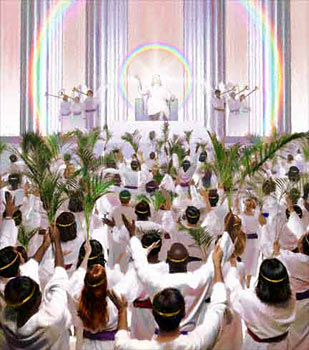
Easter 4
“There's Elton John” says mum.
If mum would ever just “stifle” and stop talking over the television she would be told who's who in due course. Nicholas Witchell, the BBC's royal correspondent does yeoman service filling in the blanks for those of us who need our memories jogged at great events. That's his job, after all. He knows. In the vision of John of Patmos (which we know in English as the Book of Revelation and which the rest of the world calls the Apocalypse), a heavenly elder turns to John the viewer and asks:
“John the Revelator” was possibly a prisoner in the island's salt mines when he had his vision. He writes like a Hebrew or Aramaic speaker who's learned a bit of journeyman's Greek along the way. He's nothing special. So why does the heavenly elder ask him about the identity of the crowd? John appears put-out at this reversal of roles: “Sir, you are the one that knows.” he says.
Try to remember that the emphasis in the elder's question is on the second part: “...where have they come from?” The “clearly not me” surrenders a little bit in the elder's explanation that these are ordinary humans who have
My life in the salt mine as an exile for Christ performs some change in my nature. The pain of faithful life is not wasted. I am a prisoner. I am a member of a persecuted religious minority in a Roman outpost. I write in a language in which I have no ease because I am impelled to testify to the victory of God in the presence of my brothers and sisters. I am a member of a tiny church with a difficult demographic and an uncertain future. My faith is pretty well all that I have. I struggle to profess that faith in the midst of colleagues, parents or children who share little of it.
I now know the answer to both sides of the elder's question:
I am not there right now.
Posted by
Raspberry Rabbit
at
4/14/2016
0
comments
Labels: 500 words on a reading, Year C Readings
Friday, April 08, 2016
Simon Peter in the school of love.
Easter 3
Year C
John 21:1-19
Jesus asks Peter – Simon, son of John, do you love me more than these?
These ‘what’ exactly? More than ‘this’ life, represented by the items of a fisherman’s trade scattered around on the beach – these nets, these spools of braided line, these floats?
Or – do you love me more than these other disciples love me?
You, Peter, pre-eminent among my followers:
Do you love me more than these others do?
The question arising between a man and a woman or a parent and a child - 'Do you love me?' - might be playful or perhaps it probes at some perceived weakness.
Do you love me? (of course you do)
Do you love me? (I want to hear you say it)
Do you love me? (I suspect that you do not)
Do you love me? (I wonder if you know what that means)
I’ll roll the dice and will hold that:
1. When Jesus asked Peter if he loved him more than these that he was referring to the other disciples gathered with them on the beach.
2. He asks the question three times because Peter has denied him three times and;
3. That when he asked Peter whether or not he loved him he was wondering if Peter knew what that meant.
Because it is not clear that we always know what love means.
You'll have heard of the well-known “tussle” here in the conversation between Jesus and Peter:
Three times Jesus asks Peter whether he loves him and twice he uses the Greek word (agapao) which refers to the type of love which gives and sacrifices, a love which lifts up the beloved. Peter keeps replying “Yes, Lord I love you” and uses the word (phileo) which is a more ordinary emotional attachment or affection.
You would expect that with the the second time of asking Peter would have twigged that the repeated question with a particular word was meant to hammer him into shape but, in fact, it is Jesus who draws near to Peter and uses Peter’s inadequate word for love in his final question: "Peter, do you love me?"
Peter has not yet fathomed the love that Jesus asks about. Jesus, though, will begin in the place where his disciple stands and use the words that Peter can speak and know here in this School of Love which convenes on a Galilean beach. It was the same way he encountered Thomas in the School of Faith which met behind locked doors in Jerusalem in last week’s Gospel reading.
Jesus starts where these disciples are but the lesson does not finish there.. The School of Love will carry on. Peter will come to learn love’s meaning. Jesus finishes with the words: “Follow me”.
Posted by
Raspberry Rabbit
at
4/08/2016
0
comments
Labels: 500 words on a reading, Year C Readings